
About 2,200 years ago, a Greek guy named Archimedes said he could move the whole world. All he needed was a stick.
Okay, a lever. And somewhere to stand.
His actual line: "Give me a place to stand, and with a lever I will move the world."
I love that line, because it's the whole human story in one sentence. One person, with a long enough lever, doing what used to take a hundred.
Stay with me. This one has a time traveler, a pile of sand and a pond in it. By the end, I think you'll lose a little sleep over it, like I do. The good kind.
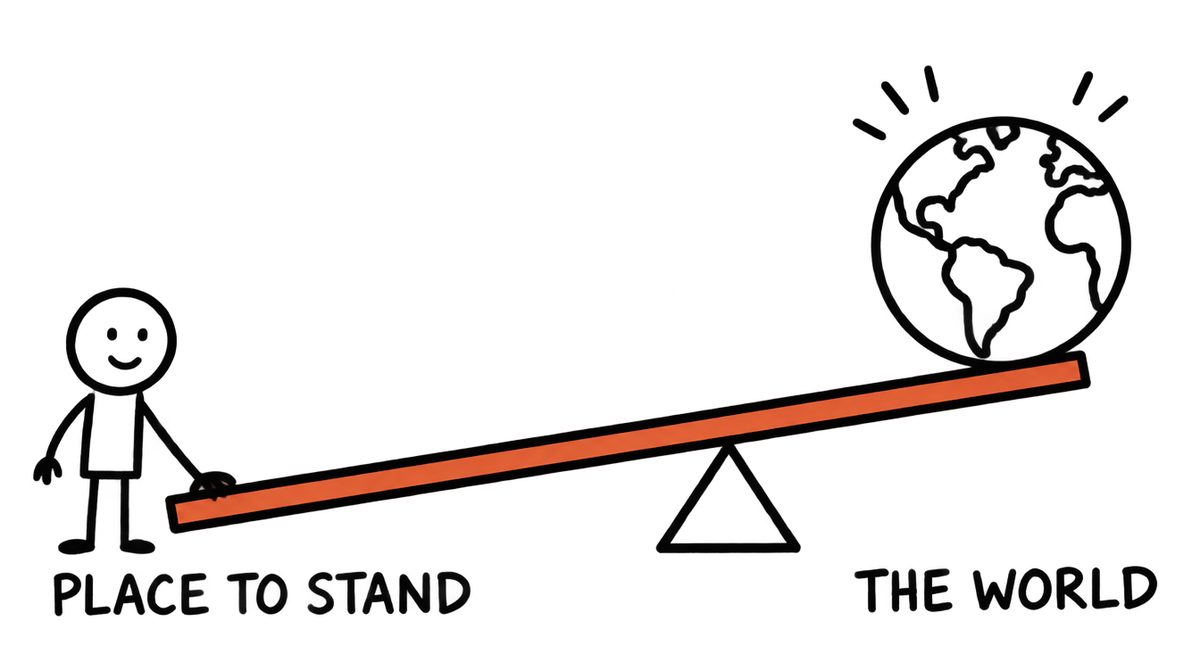
We Keep Finding Longer Levers
A lever is anything that lets one person do more than one person should be able to do.
The wheel was a lever. So was getting an animal to pull the cart for us. Then the engine. Electricity. The computer. The internet. The phone in your pocket.
Each one let a regular person do the work of a lot of people.
I call the time we're in now the age of AI help. AI is the newest lever, and the longest one yet.
But here's the part that gets me. Look at the gaps between the levers.
From the wheel to the engine: about 5,000 years.
From ChatGPT showing up to AI that can actually click around and do real work on your computer: about three years.
Five thousand years. Then three.
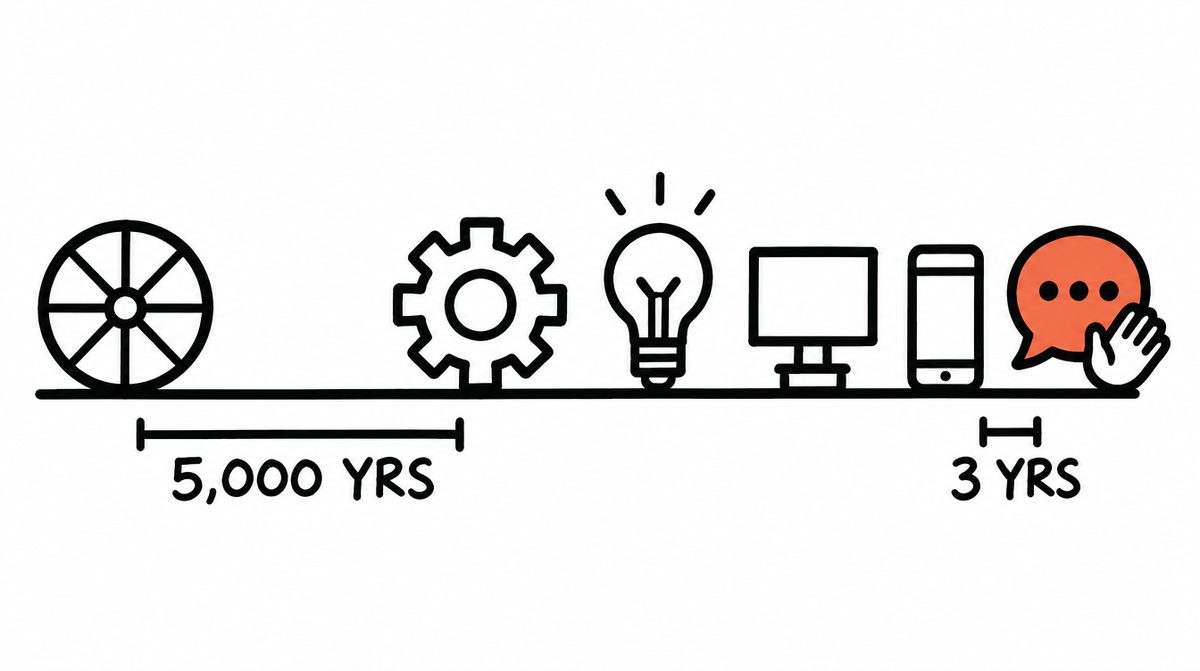
Draw that on paper and you get a line that crawls along almost flat for thousands of years, then shoots nearly straight up.
The levers keep coming faster. And we're living in the steepest part of the curve.
Why It Keeps Speeding Up
So why are the gaps shrinking?
There's a guy named Ray Kurzweil who's been predicting this stuff for decades. He has a name for it: the law of accelerating returns.
You don't need the theory. Here's the whole thing in one line:
Every tool helps build the next tool faster.
Think about a shop. With a hammer, you build a workbench. With the workbench, you build better tools. With better tools, the next project goes up in half the time.
Now picture that same loop, except the tools are machines, and each machine helps build a smarter one.
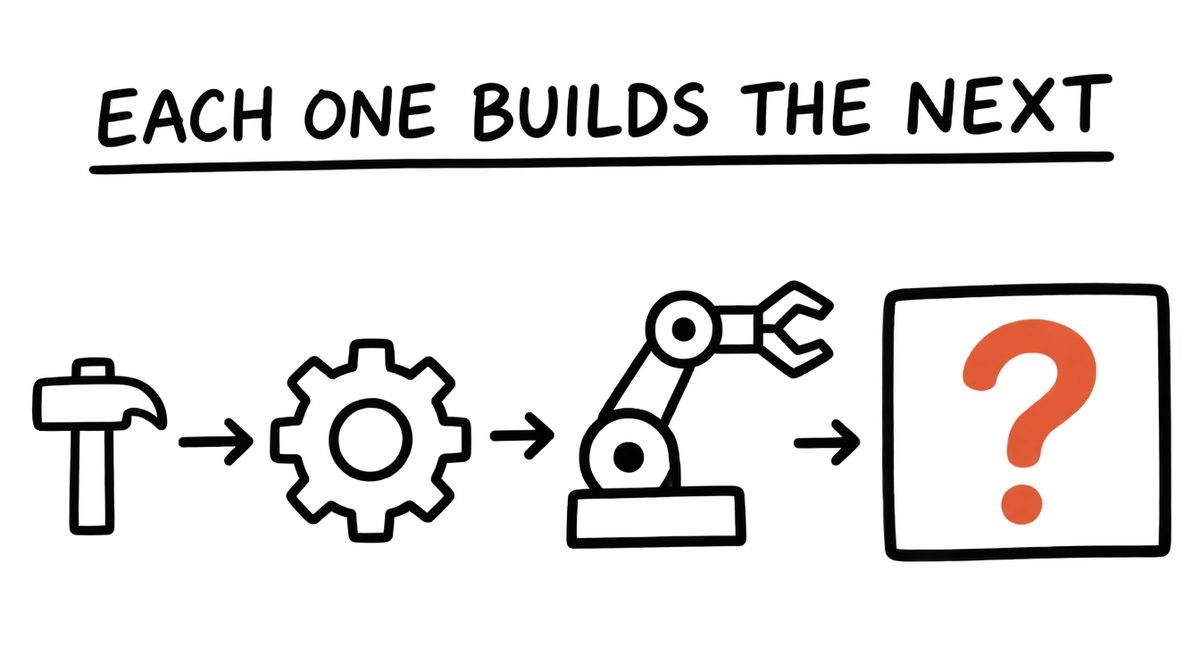
That's it. Each lever helps build the next lever. So the next one shows up sooner.
A Visitor From 1750
Here's a way to feel how fast that is. This one isn't mine. It's a thought experiment from the writer Tim Urban, and I've been telling it to anybody who'll stand still.
Grab someone from the year 1750 and bring them to today.
Put them in a car on 69. Point at a plane overhead. Then hand them your phone with a game playing on it, live, from the other side of the world.
They wouldn't just be impressed. Tim's point is the shock might actually kill them.
(To be fair, a few Colts games have nearly done that to me. Different reason.)
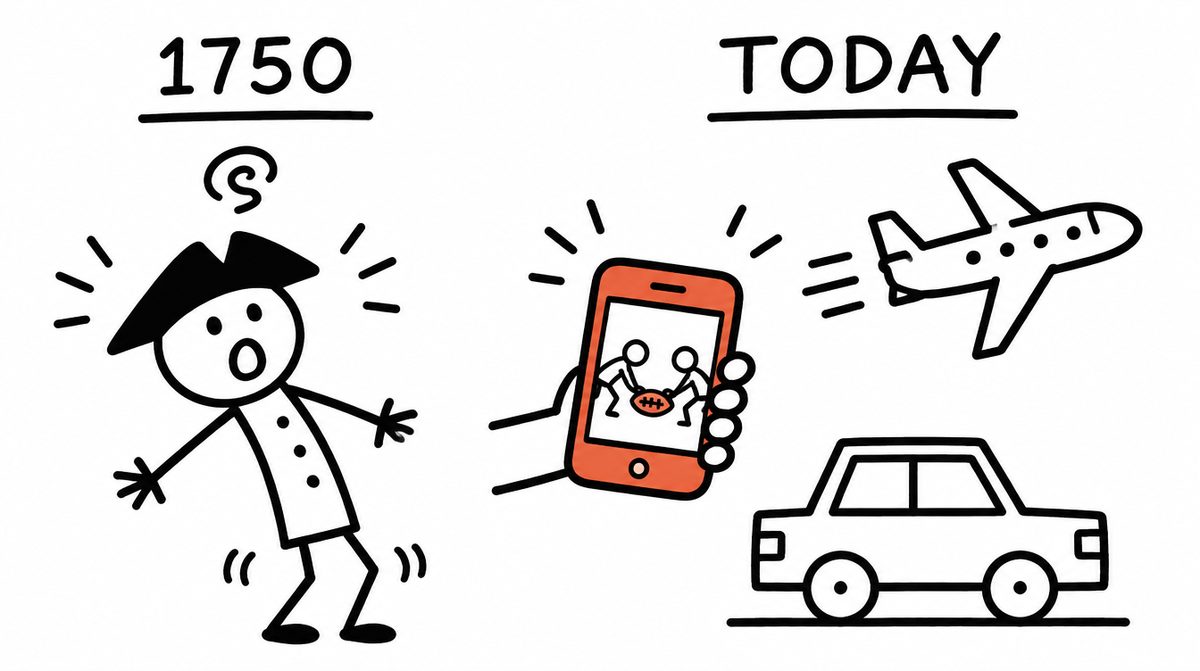
Now flip it.
Our friend from 1750 wants to give somebody else that same shock. How far back does he have to go?
1500? Nope. Those folks would be impressed, but nobody's fainting.
1000? Still no.
He has to go all the way back to 12,000 BC. Before farming. Before anybody planted a single seed on purpose.
That's how far back you have to go to find someone who'd be as floored by 1750 as 1750 would be by us.
So count the jumps.
Almost 14,000 years for the first big shock.
Then just 250 years for the next one.
And the jump after that? It's happening right now. In a few years, not a few centuries.
Same story as the levers. The gaps keep shrinking.
We Taught Sand To Think
And the newest lever is the strangest one of all. This is my favorite part.
Computer chips are made of silicon. Silicon is basically purified sand.
So think about this.
We took sand. We melted it into tiny circuits. We ran lightning through it.
And then we taught it to think.
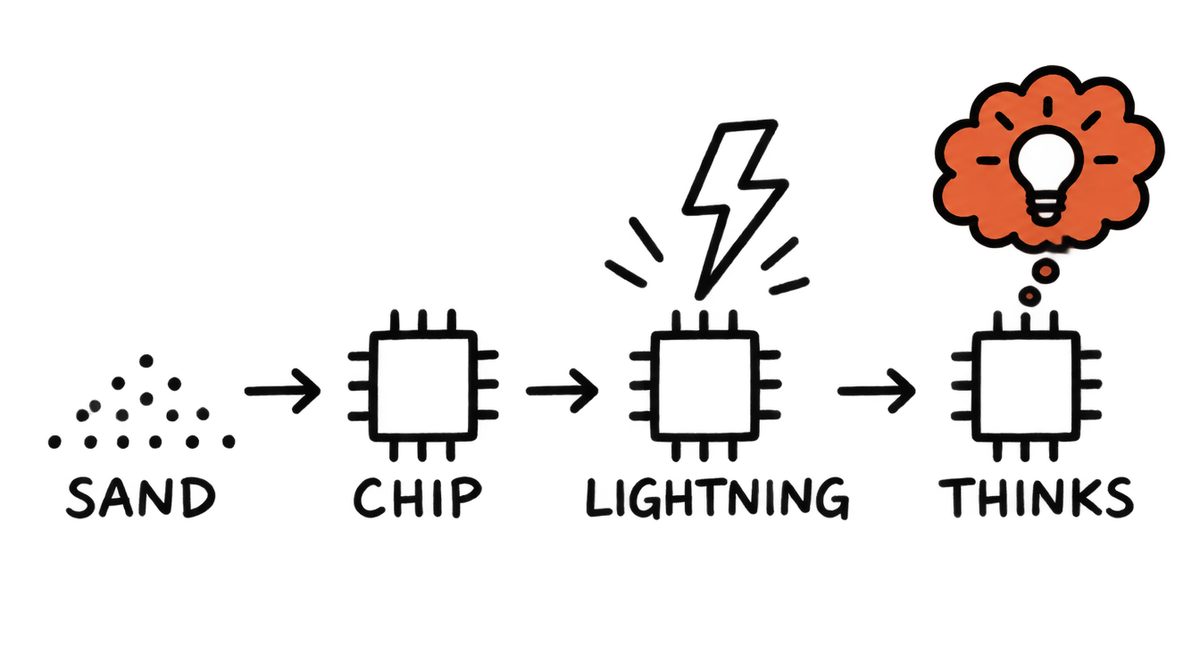
Sand. We taught sand to think.
If that doesn't blow your mind a little, I don't know what will.
Doubling Is Sneaky
One more piece, and it's the one that explains the title.
In 1965, a guy named Gordon Moore, who went on to co-found Intel, noticed something about those sand chips. The number of tiny parts on a chip was doubling on a schedule. It settled at about every two years. People call it Moore's Law.
Doubling sounds boring. It isn't. Doubling is sneaky.
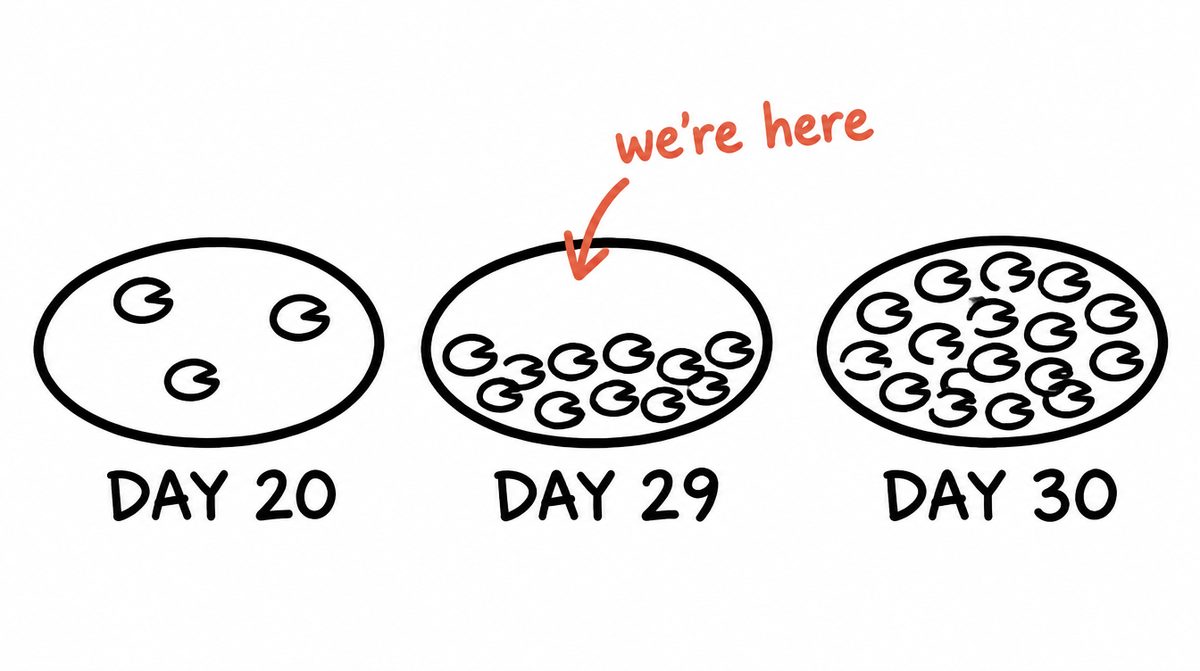
Picture a pond where the lily pads double every day. Two become four. Four become eight.
For weeks, you walk past and barely notice.
On day 29, the pond is only half covered. Looks fine. Plenty of open water.
Day 30? Covered.
Half a pond to a whole pond, in one day. That's doubling.
Here's another one. Take a regular piece of paper and fold it in half 42 times. It would reach the moon.
That kind of doubling is how the phone in your pocket ended up with more computing power than NASA had to put people on the moon.
So What Day Is It?
Put it all together.
The levers keep coming faster. Every tool helps build the next one. And the newest lever, the sand that thinks, is riding the same kind of doubling curve.
Right now, with AI, we're around day 29.
Half a pond. Looks fine. Lots of open water. Most people walk right past it.
And here's the part I love. Remember No. 4, Einstein in the basement? Most of the world is still asleep.
That's not scary. For a small business owner, that's the best news in years. You're not late. You're standing at the pond on day 29, wide awake, while most of your competitors are asleep.
Steal This
Steal this: the day 30 question. Tonight, open ChatGPT or Claude, tap the microphone, and say:
"I run a [your business] in [your town]. Picture two years from now, when most of my customers use AI every day. What are three things they'll expect from a business like mine that I don't do yet? Before you answer, ask me a few questions about my business, one at a time."
Then circle the one that makes you go "huh."
Archimedes said all he needed was a place to stand.
Day 29, wide awake, with the newest lever in your pocket? That's a pretty good place to stand.
It's day 29. If you want help making a plan for day 30, text GENIE to (317) 751-2693, or grab 15 minutes with me at 2guysandagenie.com/book.
Next up: No. 10, "Off the Ground." Why your first week with AI feels like all fuel and no flight, and what happens once you're up.